
Medically reviewed by Dr. Scott Maymon, ND, MPH · ~9 min read · Updated August 2026
Key takeaways
- RF microneedling can visibly improve stretch marks — but it improves their appearance rather than erasing them.
- It works by rebuilding collagen and elastin. Micro-needles plus radiofrequency heat prompt the deeper skin to remodel over time.
- Newer red or purple marks respond faster than older white or silver ones, though both can improve.
- Most people need about 3–6 sessions, spaced 4–6 weeks apart, with results building gradually.
- Research supports it. A 2024 review of 11 studies found RF microneedling produced significant improvement, with patient satisfaction comparable to or better than lasers.
Stretch marks form when skin stretches faster than its collagen and elastin fibers can adapt, causing the middle layer (the dermis) to thin and tear. They are completely harmless — but if you would like smoother, more even-looking skin, RF microneedling is one of the more effective in-office options available today. Here is an honest look at how it works, what results are realistic, and what to expect from treatment.
Does RF microneedling work for stretch marks?
Yes, RF microneedling can meaningfully improve the appearance of stretch marks by stimulating new collagen and elastin in the dermis, which makes the marks smoother, firmer, and less visible over a series of treatments. What it will not do is erase them entirely, and any provider who promises complete removal is overselling.
The evidence is encouraging. A 2024 systematic review and meta-analysis of 11 studies found that radiofrequency microneedling produced significant clinical improvement in stretch marks, with patient satisfaction comparable to lasers — and higher than non-laser options.
In a randomized controlled trial of postpartum women with older white abdominal stretch marks, nanofractional radiofrequency delivered the best results of the groups studied, with no adverse effects reported.
In short, this is a treatment with real clinical backing, not just marketing.
How does RF microneedling improve stretch marks?
RF microneedling works below the surface, combining two collagen-building triggers at once. Fine needles create controlled microchannels in the skin while delivering radiofrequency energy into the dermal layer. The controlled heat encourages collagen production and elastin remodeling and boosts blood flow to the area, so the skin gradually rebuilds itself stronger and more evenly.
Because the treatment works in the dermis, where stretch marks actually live, improvement continues for months as your body lays down new collagen. This remodeling process can help:
- Reduce the depth of stretch marks
- Improve skin texture and firmness
- Even out skin tone in the treated area
- Support long-term collagen and elastin production
It is a close cousin of traditional microneedling, but the added radiofrequency energy reaches deeper and drives more remodeling — the difference we break down in RF microneedling vs. microneedling.
What causes stretch marks?
Stretch marks form when skin is stretched or shrinks faster than its collagen and elastin can keep up, tearing the dermis and leaving visible streaks. They start red, pink, or purple and fade to silver or white over time. Common stretchmark triggers include:
- Pregnancy: Rapid skin stretching plus hormonal changes
- Weight gain or loss: Quick changes in body size
- Growth spurts: Common in adolescence
- Muscle building: Fast gains from training
- Corticosteroid use: Prolonged steroid creams or pills can thin the skin
- Genetics: Some people are simply more prone to them
None of this is a reflection of health or effort. Stretch marks are extremely common and completely harmless. Knowing the cause mostly helps set expectations for treatment, as newer inflammation-stage marks tend to respond fastest.
RF microneedling before and after: what results look like
Results appear gradually and build with each session — you will not walk out with dramatically different skin the same day. Over weeks and months, treated stretch marks typically become shallower, softer in color, and less noticeable against the surrounding skin.
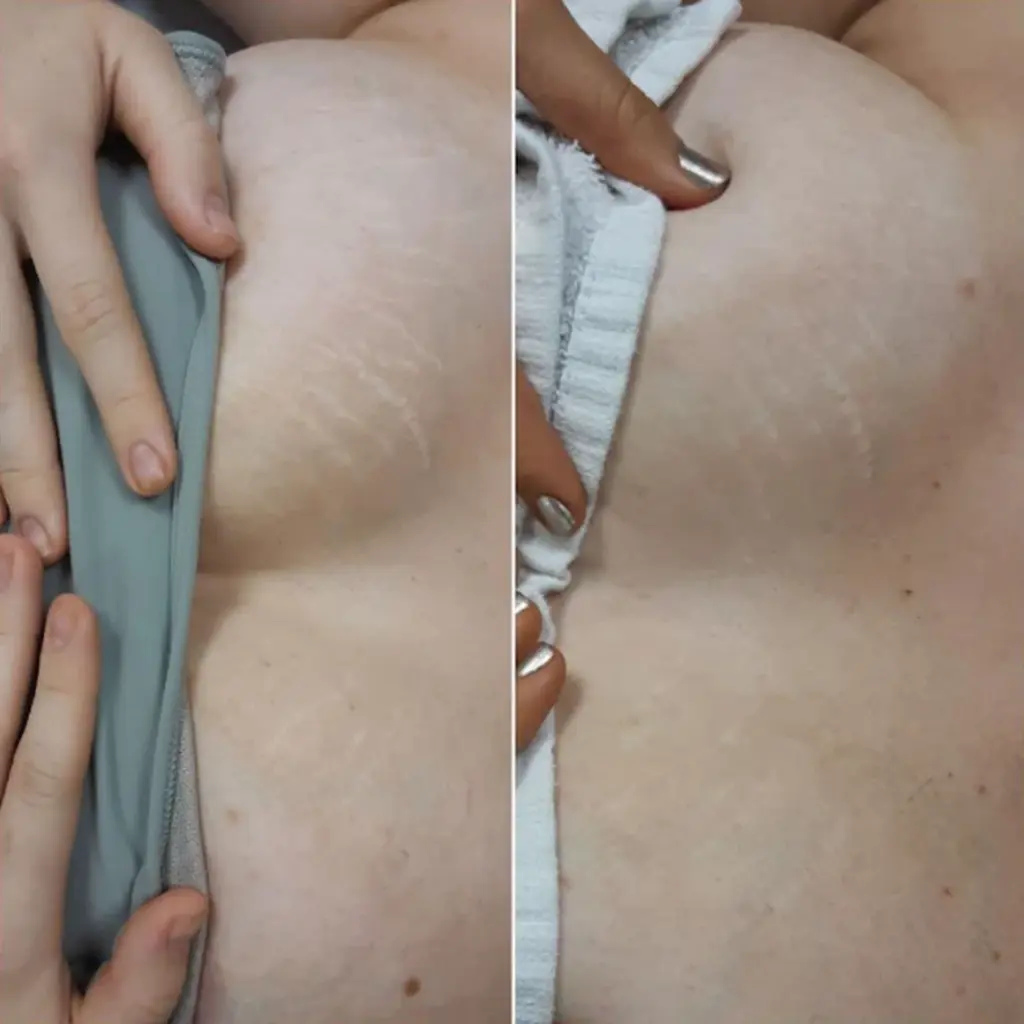
Set expectations realistically: Newer marks tend to show change sooner, while older ones improve more slowly. A single session helps, but a plan of several treatments is what produces the visible before-and-after difference most people are after.
To see how the skin heals between visits, our guide to microneedling healing stages walks through the timeline.
Which stretch marks respond best?
RF microneedling can improve both new and old stretch marks, but color is the best clue to how quickly you will see change. Newer marks that are red, pink, or purple are still actively healing and often respond faster. Older marks that have turned white or silver are more mature and usually need additional sessions. However, because RF energy remodels the deeper dermis, these older stretch marks can still improve.
RF microneedling is used across the body wherever stretch marks appear. The most common areas are the abdomen and stomach, thighs, hips, buttocks, breasts, and upper arms. Settings are customized to each area, the severity of the marks, your skin type, and your goals.
Many patients opt for RF microneedling to treat skin changes after pregnancy or weight loss. If you’re anticipating a sudden drop in weight, preventing loose skin during weight loss is a useful read during your journey.
Does RF microneedling hurt?
Most people tolerate RF microneedling well. A topical numbing cream is applied about 30 minutes beforehand, so treatment usually feels like light pressure with a sensation of warmth from the radiofrequency energy. Afterward, the area may feel tender or sunburn-like for a day or two.
To be fully transparent: Research has found RF microneedling can involve a bit more post-treatment discomfort than some laser options, but the trade-off is a strong remodeling result. At Pure Body Health, we will adjust needle depth and energy to keep you comfortable while still treating effectively.
How many sessions will I need?
Most stretch-mark plans involve about 3 to 6 sessions, spaced roughly 4 to 6 weeks apart. Because collagen builds gradually, improvement compounds with each visit rather than arriving all at once.
The exact number of sessions depends on the age, depth, and width of your stretch marks, the treatment area, your skin type, and how your body heals. After a consultation, your provider will recommend an individualized plan and a realistic timeline.
What are recovery and aftercare like?
Downtime is minimal — usually redness and mild swelling for 24 to 48 hours, similar to a light sunburn. Most people return to normal activities the next day.
To protect your results, keep the area clean, avoid heavy sweating, hot tubs, and direct sun for a few days, skip active skincare (retinoids, acids) until the skin settles, and apply sunscreen diligently once healed. Sun protection matters, because new collagen is best preserved on skin that is not being re-damaged by UV.
How much does RF microneedling for stretch marks cost?
Cost depends on the size of the area and the number of sessions in your plan. Nationally, RF microneedling commonly runs a few hundred dollars per session, and stretch-mark treatment uses several sessions, so it is best understood as a package rather than a one-time fee.
Because stretch-mark treatment is cosmetic, it is typically not covered by insurance, and Pure Body Health does not accept traditional heath insurance. At your consultation, Dr.Sarah Stone reviews your skin and gives you an exact quote and any package options, so there are no surprises.
RF microneedling vs. microneedling vs. laser
All three build collagen, but they reach different depths and suit different skin. Here is how they compare for stretch marks.
Comparing collagen-building options for stretch marks
| RF microneedling | Traditional microneedling | Fractional laser | |
|---|---|---|---|
| How it works | Micro-needles + radiofrequency heat in the dermis | Micro-needles create controlled micro-injury | Light energy resurfaces & heats tissue |
| Depth of remodeling | Deeper (heat reaches lower dermis) | More superficial | Variable by device |
| Darker skin tones | Generally well tolerated | Well tolerated | Some lasers carry higher pigment risk |
| Best for | Deeper or older marks; skin laxity | Early, superficial marks | Texture; provider-dependent |
In head-to-head research, RF microneedling and lasers produced comparable satisfaction, with RF microneedling showing a slight edge in measured improvement in some studies. A practical advantage of RF microneedling is that it also tightens loose or crepey skin around the marks, which is useful after pregnancy or weight loss, where texture and laxity often dissipate together.
Can you combine RF microneedling with PRP?
Yes, pairing microneedling with platelet-rich plasma (PRP) adds your own growth factors to the healing response, which can accelerate repair and enhance results. Because PRP comes from your own blood, many patients like it as a natural way to boost outcomes; our overview of microneedling with PRP explains how the combination works.
Is RF microneedling safe for all skin tones?
Generally, yes, this is one of RF microneedling’s advantages. Because the radiofrequency energy heats the dermis without targeting melanin the way some lasers do, it carries a lower risk of pigment changes on deeper skin.
Studies in patients with darker (Fitzpatrick IV–VI) skin have reported meaningful stretch-mark improvement with minimal adverse effects. As always, safety depends on a trained provider choosing the right settings for your skin.
Can I get RF microneedling postpartum or during pregnancy?
RF microneedling is not performed during pregnancy. Postpartum stretch marks are very treatable, but treatment is scheduled after pregnancy — and your provider will advise on timing if you are breastfeeding.
For the full picture on timing and safety, read our page on the safety of microneedling while pregnant?
Who is a good candidate for RF microneedling?
Most healthy adults bothered by the appearance of stretch marks are good candidates, across a wide range of skin tones. Because RF energy does not target pigment the way some lasers do, it is often the preferred option for olive and deeper skin.
RF microneedling may not be appropriate if you are pregnant, have an active skin infection or breakout in the treatment area, a history of keloid scarring, certain bleeding or immune conditions, or have recently used specific medications. These restrictions are why every plan starts with a consultation and health review. Your provider confirms it is a fit and sets realistic goals before any treatment.
A note on RF microneedling devices
You will see many device names — Scarlet RF, Morpheus8, Potenza, Secret RF, Infini, VirtueRF — and they work on the same core principle: micro-needles plus radiofrequency heat to remodel the dermis. Differences come down to needle design, energy delivery, and depth control.
Pure Body Health uses the Scarlet RF system. Honestly, the device matters less than the hands running it. Provider skill, the right settings for your skin, and a sensible treatment plan drive results more than the brand on the handpiece.
Stretch mark treatment in Tempe, AZ at Pure Body Health
RF microneedling is not a one-size-fits-all treatment. At Pure Body Health, Dr. Sarah Stone, ND customizes every plan around your skin type, the age and severity of your stretch marks, and your cosmetic goals. She then uses our Scarlet RF microneedling system to deliver precise, controlled treatment. Tailoring the protocol is how patients achieve smoother skin and steady, progressive improvement.
You can also explore our broader natural aesthetics and body contouring and medical aesthetics options, which often pair well with stretch-mark care.
Book an RF microneedling consultation in Tempe, AZ
See whether RF microneedling is right for your stretch marks and get a personalized plan and quote. Call (480) 427-0442 or visit us at 1553 W Todd Dr #106, Tempe, AZ 85283. We serve South Tempe, Ahwatukee, Chandler, Scottsdale, and the greater Phoenix area. Request a consultation.
Frequently asked questions
Can RF microneedling remove stretch marks completely?
No. RF microneedling cannot fully eliminate stretch marks, but it can significantly improve their appearance by stimulating new collagen and elastin within the skin, making them smoother and less noticeable.
Does RF microneedling hurt?
Most people tolerate it well. A topical numbing cream is applied first, so treatment feels like light pressure with warmth. Some tenderness afterward is normal and fades within a day or two.
How long does it take to see results?
Some firmness may appear within a few weeks, but collagen remodeling continues for several months, and results become more apparent after a series of treatments.
How many sessions will I need?
Most stretch-mark plans use about 3–6 sessions spaced 4–6 weeks apart, individualized to the age, depth, and location of your marks and your skin’s response.
Does it work on old white stretch marks?
Yes, though older white or silver marks usually improve more gradually than newer red ones and may need additional sessions. Because RF energy remodels the deeper dermis, mature marks can still improve.
How much does it cost?
Cost depends on the treatment area and number of sessions. Nationally it commonly runs a few hundred dollars per session, and it is usually not covered by insurance since it is cosmetic. We provide an exact quote at your consultation.
Is it safe for darker skin tones?
Generally, yes. Because RF energy does not target melanin the way some lasers do, studies suggest it is well tolerated across a range of skin tones, including deeper skin, when performed by a trained provider.
How much improvement is realistic?
Set your expectations around meaningful softening rather than disappearance. Many patients see a substantial reduction in how visible their stretch marks are over a full series — smoother texture, more even color, and firmer skin — but complete removal is not a promise anyone should make.
Which areas are hardest and easiest to treat?
In general, marks on the breasts and thinner-skinned areas tend to respond well and quickly, while the inner thighs and buttocks can be more stubborn and may need extra sessions. Your provider maps this out for your specific pattern at consultation.
Do stretch marks on the breasts respond, even when white?
Yes — mature white marks on the breasts often respond nicely and sometimes need fewer sessions than expected. It is still individual, so a consultation gives the most accurate picture.
When should I start if I want results by summer?
Start in the cooler months. Because results build over a series spaced weeks apart, and treated skin needs sun protection while it heals, beginning in fall or winter is the most reliable way to be ready for warmer, more skin-baring weather.
Medical references
- Sun X, Jia X, Huang L. Microneedling Therapy for Striae Distensae: Systematic Review and Meta-Analysis. Aesthetic Plast Surg. 2024. pubmed.ncbi.nlm.nih.gov/38509316
- Shu X, et al. Treatment of Stretch Marks Using Nanofractional Radiofrequency (RCT). Dermatol Ther. 2023. pmc.ncbi.nlm.nih.gov/articles/PMC10264298
- Park KY, et al. Fractional radiofrequency microneedling for striae distensae. J Dermatolog Treat. pubmed.ncbi.nlm.nih.gov/32323904
Medical disclaimer
This article is for educational purposes and is not a substitute for personalized medical advice. Results from RF microneedling vary by individual and are not guaranteed. Before/after images depict specific patients and may not represent typical results. A consultation is needed to determine whether treatment is appropriate for you.