
Written and medically reviewed by Dr. Scott Maymon, ND, MPH and Dr. Sarah Stone, ND, Pure Body Health, South Tempe, AZ.
Key takeaways
- Menopause weight gain is driven mostly by falling estrogen, not by eating more or trying less.
- Lower estrogen shifts fat storage toward the belly, age-related muscle loss lowers your resting metabolism, and insulin sensitivity often drops, all at once.
- Poor sleep and higher cortisol during this stage make the pattern worse and harder to break with diet alone.
- GLP-1 medications may help by curbing appetite and improving blood-sugar handling, which targets two of the root problems directly, but they are a tool, not the whole answer.
- The most durable results come from a whole-body plan: evaluating and supporting hormones, protecting muscle with protein and strength training, fixing sleep and stress, and using medication or peptides where appropriate.
If the scale has crept up since your forties or fifties and your usual habits are not fixing it, you are not imagining it, and you have not lost your discipline. Weight gain around menopause is one of the most common concerns women bring to us, and it has a clear biological explanation. The body’s hormones are changing, and with them the rules for how it stores fat and burns energy. Once you understand what is happening, the way forward gets clearer.
Why does menopause cause weight gain?
Menopause weight gain comes mostly from falling estrogen, not from eating more. As estrogen declines through perimenopause and into menopause, several things shift together: fat moves toward the belly, muscle slowly falls away and lowers the calories you burn at rest, and the body handles blood sugar less efficiently. None of these is about willpower. They are metabolic changes, and they stack.
Weight gain in menopause is a hormone story, not a discipline story. When estrogen falls, the body changes where it stores fat and how efficiently it burns energy, so the same routine that once kept your weight steady no longer does.
Because these changes build on each other, dieting harder often backfires: cutting calories too far speeds muscle loss, which lowers metabolism further and makes weight easier to regain. The more useful question is not how to eat less, but how to work with the hormones driving the change. If you are noticing these shifts early, our overview of the signs of perimenopause can help.
The four reasons the weight shows up, and moves to your belly
1. Estrogen changes where fat is stored
Estrogen acts like a traffic director for fat storage. Before menopause, estrogen favors storing fat under the skin around the hips and thighs. When estrogen declines, that signal changes, and fat storage shifts more toward the abdomen, especially visceral fat around organs. This is why some women notice their waistline changing even when their weight has not changed dramatically. It is a change in the location of fat, not only the amount, and it is the single biggest reason menopause belly fat is such a common complaint.
2. Muscle loss lowers your metabolism
Starting in your thirties, and accelerating around menopause, the body gradually loses muscle unless you actively work to keep it. Muscle is metabolically expensive tissue, so losing it lowers the calories you burn at rest, and the same meals that once maintained your weight now tip you toward a surplus.
3. Insulin sensitivity drops
Estrogen helps the body respond to insulin, the hormone that moves sugar out of the blood and into cells. As estrogen falls, many women become less sensitive to insulin, so the body releases more of it and stores more of what you eat as fat, especially around the middle. This is also why cravings and energy dips can worsen, and it is a hormone problem that both nutrition and certain medications can address.
4. Sleep and cortisol make it worse
Night sweats, hot flashes, and lighter sleep are common in menopause, and poor sleep raises cortisol, the body’s stress hormone. Higher cortisol encourages belly-fat storage and drives appetite and cravings, especially for quick carbohydrates. Sleep and stress are not side issues here; they are part of the same hormonal picture.
Four forces arrive together at menopause: fat shifts to the belly, muscle quietly declines, insulin works less well, and sleep and cortisol worsen. No single diet counters all four, which is why a whole-body approach works better than any one change.
How GLP-1 medications may help
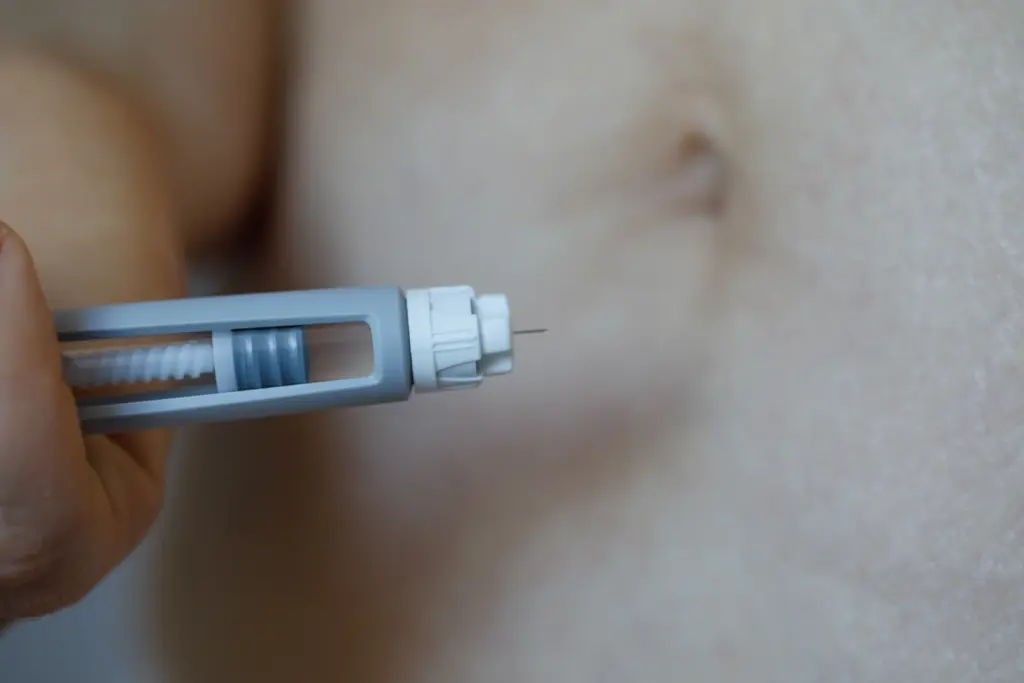
GLP-1 medications may help with menopause weight gain by curbing appetite and improving how the body handles blood sugar, which targets two of the exact problems menopause creates. These medications mimic a natural gut hormone that tells the brain you are full, slows how quickly the stomach empties, and steadies blood sugar. For a body that is suddenly hungrier and less insulin-sensitive, that can be a meaningful assist. Specifically, GLP-1 medications:
- Quiet appetite and cravings. The rise in hunger and carbohydrate cravings that comes with lower estrogen and disrupted sleep is one of the hardest parts to muscle through, and these medications lower that drive directly.
- Improve blood-sugar handling. By steadying insulin and glucose, they address the insulin-sensitivity drop that pushes fat toward the belly.
- Slow digestion so fullness lasts. Feeling satisfied on less food makes a supportive eating pattern easier to sustain.
A medication is a tool, not the whole answer. GLP-1 medications do not replace the estrogen your body is missing, and rapid weight loss on any medication can cost you muscle if the plan does not protect it, the last thing a menopausal metabolism needs. That is why we use them inside a supervised program alongside protein, strength work, and hormone support. Our article on how hormone health influences GLP-1 results explains why the same medication works better when your hormones are addressed too, and our look at whether semaglutide really helps you lose weight sets realistic expectations.
The whole-body approach that treats the root cause
The most durable results come from treating the hormonal root cause, not just the symptom on the scale. Menopause weight gain is a signal that your hormones, muscle, blood sugar, and sleep have all shifted, and a plan that addresses those directly outperforms dieting harder. Here is what that looks like with us.
Evaluate and support the hormones
Because falling estrogen sits underneath the whole pattern, we start with a thorough hormone health evaluation rather than guessing. For the right candidates, women’s hormone optimization therapy using bioidentical hormones can ease symptoms and support a healthier metabolism where it is appropriate. Candidacy is determined in a consultation, and hormone support is one part of the plan. Our summary of practical menopausal weight-gain solutions covers the options in more detail.
Protect muscle with protein and strength training
If you change only one habit, make it this one. Eating enough protein at each meal and adding strength training two or three times a week protects the muscle that keeps your metabolism up, the direct counter to age-related muscle loss. This matters even more after 60. Our guide on how to speed up metabolism after 60 covers the specifics, and a menopause-friendly way of eating shows how to hit protein and fiber targets without extreme restriction.
Fix sleep and manage stress
Because poor sleep and high cortisol feed belly-fat storage, we treat them as part of the weight plan, not an afterthought. Improving sleep quality, easing hot flashes where possible, and building in genuine stress recovery lowers cortisol and blunts the cravings that sabotage progress.
Consider peptide therapy and targeted medication
For some patients, peptide therapy supports body composition and recovery as an adjunct to the core plan, and our overview of peptide therapy for menopause explains where it fits. Where a GLP-1 medication is appropriate, we fold it into a medically supervised weight-loss program so appetite and blood sugar are helped without sacrificing muscle.
Menopause weight-loss strategies compared

No single approach solves menopause weight gain, but each addresses a specific piece.
| Approach | What it targets | Best thought of as |
|---|---|---|
| Protein and strength training | Muscle loss and resting metabolism | The non-negotiable foundation |
| Hormone evaluation and support | The estrogen shift driving the whole pattern | Root-cause care, where appropriate |
| Sleep and stress work | Cortisol, cravings, belly-fat storage | A force multiplier for everything else |
| GLP-1 medication | Appetite and insulin sensitivity | A useful tool inside a supervised plan |
| Peptide therapy | Body composition and recovery | A targeted adjunct for the right candidate |
At Pure Body Health in South Tempe, our physicians look at the whole picture: your hormones, your metabolism, your sleep, and your goals, not just the number on the scale. If menopause weight gain has stopped responding to your usual efforts, a consultation can build a plan around the cause. Book a consultation or call (480) 427-0442.
About the authors. Dr. Scott Maymon, ND, MPH, and Dr. Sarah Stone, ND, are the licensed naturopathic physicians of Pure Body Health in South Tempe, Arizona (AZ licenses #15-1497 and #15-1496). Both earned their doctorates at the Southwest College of Naturopathic Medicine in Tempe, and they work together across hormone and metabolic health, weight management, regenerative medicine, aesthetics, and men’s and women’s health. They have cared for the South Tempe and greater Phoenix community since 2015, and they write and review this content together.
Frequently asked questions
Why do women gain weight during menopause?
Weight gain in menopause is driven mostly by falling estrogen, not by eating more. Lower estrogen shifts fat storage toward the belly, age-related muscle loss lowers the calories you burn at rest, and insulin sensitivity often drops, while poor sleep and higher cortisol add to it. Together these changes make weight easier to gain even when your habits have not changed.
Why does menopause cause belly fat specifically?
As estrogen declines, the body stores more fat around the abdomen and less around the hips and thighs. This is a change in where fat is stored, not only how much. The result is often a thicker midsection even when total weight has barely moved, which is why belly fat is one of the most common menopause complaints.
Can GLP-1 medications help with menopause weight gain?
They can help as one tool. GLP-1 medications curb appetite, slow digestion, and improve how the body handles blood sugar, which targets the appetite and insulin problems menopause creates. They work best inside a supervised plan that also protects muscle and, where appropriate, addresses the hormone shift underneath.
How can I lose weight during menopause naturally?
The most effective steps protect muscle and steady your hormones and blood sugar. Eat enough protein at each meal, add strength training two or three times a week, prioritize sleep, and manage stress. Addressing the hormone shift with a licensed provider makes these habits work far better than dieting harder does.
Is menopause weight gain permanent?
No. The metabolic changes of menopause are real, but they respond to the right approach. Protecting muscle with protein and strength work, supporting hormones and blood sugar, improving sleep, and using medication or peptide therapy where appropriate can shift the trend. Results vary, and a whole-body plan works better than any single fix.
This article is educational and is not medical advice. It is not intended to diagnose, treat, prevent, or cure any disease. GLP-1 medications, hormone therapy, and peptide therapy are not appropriate for everyone, and candidacy is determined by a licensed provider. Individual results vary. Always talk with your healthcare provider about your situation.